
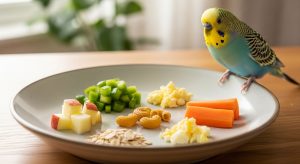
Quick answer: Budgies should avoid most human snacks. Crisps, biscuits, sweets, chocolate, salted nuts, popcorn with seasoning and processed foods can be too salty, sugary, fatty or toxic for a small bird. Safer treats are plain vegetables, herbs, a small amount of fruit, or millet used sparingly.
This guide explains which snacks are dangerous, which plain options may be acceptable in tiny amounts, and what to offer instead.
Caught Snack-Handed: Can Your Budgie Share Your Treat?
We’ve all been there. You settle onto the couch with a bowl of popcorn or a piece of toast, and suddenly you feel a tiny pair of eyes on you. Your budgie, perched on their cage or play gym, is watching your every move, head tilted, chirping inquisitively. That little beak is practically watering. The temptation to share just a tiny crumb is immense. It’s a bonding moment, right?
But then, the responsible-pet-owner alarm bells start ringing. Human food is for humans, and bird food is for birds. We’ve heard the horror stories about avocado, chocolate, and salt. The last thing any of us wants is to accidentally harm our feathered friends. So, what’s the verdict? Is sharing food always a no-go zone?
Here’s the good news: while the vast majority of our processed, seasoned, and sugary snacks are absolutely off-limits, there is a small, select group of human foods that are surprisingly safe for your budgie to sample. The key words here are ‘select’ and ‘sample’. We’re talking about minuscule amounts, served as a rare treat, not a regular meal.
In this in-depth guide, we’ll explore seven human snacks that, when prepared correctly, can be a safe and exciting treat for your budgie. We’ll also cover the non-negotiable rules of sharing and the foods that must be avoided at all costs.
The Golden Rules of Sharing: Before You Offer a Bite
Before we dive into the list of approved snacks, we need to establish some ground rules. These aren’t just suggestions; they are essential for your budgie’s safety. Think of this as your budgie-snack-sharing manifesto.
Rule #1: Moderation is Everything
Imagine your budgie’s tiny body. Their entire digestive system is a fraction of the size of ours. A piece of food that seems minuscule to you can be a massive meal for them. Any shared human food should be considered a treat, not a part of their staple diet. We’re talking about a piece the size of your pinky fingernail, or even smaller. Overfeeding can lead to obesity, digestive upset, and nutritional imbalances.
Rule #2: Plain, Plain, and More Plain
This is the most critical rule. Budgies cannot process salt, sugar, butter, oils, or any kind of seasoning. What tastes bland to us is perfect for them. Any food you share must be completely unseasoned. No salt, no garlic powder, no herbs, no sauces, no butter, no sugar. Zero exceptions.
Rule #3: The Triple-Check for Hidden Dangers
Many human foods contain ingredients that are toxic to birds, even in trace amounts. Always be aware of what’s in the food you’re considering sharing. The biggest culprits to watch out for are:
- Avocado: Highly toxic to birds.
- Onion and Garlic: Can cause anemia.
- Chocolate: Contains theobromine, which is poisonous to birds.
- Xylitol: An artificial sweetener that is extremely dangerous.
If you’re ever unsure, the safest option is to not share it.
Rule #4: Organic and Well-Washed is Best
Pesticides and herbicides that might be present on the surface of produce can be harmful to a small bird. Whenever possible, opt for organic versions of foods you might share. Regardless, always wash all fruits and vegetables thoroughly before offering a piece to your budgie.
7 Human Snacks That Get the Budgie Stamp of Approval
With the golden rules firmly in mind, let’s get to the fun part! Here are seven common human snacks that you can safely share with your little companion, provided you follow the preparation guidelines to the letter.
1. Plain, Air-Popped Popcorn
Why It’s Safe (and Even Beneficial)
Popcorn is a whole grain, and in its purest form, it offers a bit of fiber. But the real appeal for a budgie is the texture and the fun of shredding it. It’s a fantastic enrichment treat that engages their beak and their brain. It’s like a tiny, edible toy!
How to Prepare and Serve It
This is crucial: the popcorn must be air-popped with absolutely no salt, butter, or oil. The pre-bagged microwave stuff is a definite no. Pop the kernels in an air popper or in a paper bag in the microwave. Let it cool completely. Offer your budgie a single, fully-puffed piece. They will likely enjoy tearing it apart more than actually eating it.
The “Too Much” Warning
One or two small pieces are more than enough. It’s mostly air and not very nutrient-dense, so it should not displace their regular, healthier foods.
2. Cooked Pasta or Rice
Why It’s Safe (and Even Beneficial)
Plain, cooked pasta and rice are excellent sources of carbohydrates, providing a quick energy boost. The soft texture is also very appealing to many budgies and easy for them to manage.
How to Prepare and Serve It
Boil the pasta or rice in plain water until soft. Do not add salt to the water. Drain it and let it cool completely. You can offer a single piece of pasta (like an elbow macaroni or a small piece of spaghetti) or a few grains of rice. Many owners wonder about brown or white rice; both are fine, but brown rice offers more fiber and nutrients. Ensure there is absolutely no sauce or seasoning on it.
The “Too Much” Warning
Carbs are filling. A tiny amount is sufficient. A single noodle or a small clump of rice (about the size of a pea) is a good limit for a treat.
3. Hard-Boiled Egg
Why It’s Safe (and Even Beneficial)
This is a powerhouse of nutrition for your budgie. Hard-boiled eggs are packed with protein, which is essential for feather health, and vitamins like Vitamin A and D. The shell itself, when cleaned and crushed, is an excellent source of calcium, which is vital for bone health, especially for female birds.
How to Prepare and Serve It
Boil an egg until it’s completely cooked through. Let it cool, then peel it. You can mash up a small amount of both the yolk and the white. Serve a tiny spoonful in a separate treat dish. You can also wash the shell, bake it at a low temperature to sterilize it, crush it into a fine powder, and sprinkle a tiny bit over their regular food.
The “Too Much” Warning
Egg is very rich. A small amount (about a quarter-teaspoon of the mashed egg) once or twice a week is plenty.
4. Unsweetened, Plain Cereal
Why It’s Safe (and Even Beneficial)
Certain cereals can be a fun, crunchy treat. Look for whole-grain, low-sugar options like plain Cheerios or bran flakes. They provide a satisfying crunch that budgies love and can be a source of fiber and whole grains.
How to Prepare and Serve It
Check the ingredients list first! Ensure there is no added sugar, artificial sweeteners (especially Xylitol), or chocolate. Serve it dry, right out of the box. You can offer a single Cheerio for them to hold and nibble on, or crush up a bran flake.
The “Too Much” Warning
This is a processed food, so it should be an occasional treat. One Cheerio or half a bran flake is a perfectly sized portion.
5. Steamed or Boiled Vegetables
Why It’s Safe (and Even Beneficial)
While many budgies enjoy raw veggies, some prefer the softer texture of cooked ones. Steamed or boiled vegetables like peas, carrots, broccoli, corn, and sweet potato are loaded with vitamins and minerals. Cooking can sometimes make the nutrients easier for them to absorb.
How to Prepare and Serve It
Steam or boil the vegetables in plain water until tender. Let them cool completely. You can offer a single pea, a tiny floret of broccoli, or a small, mashed piece of sweet potato. Exploring safely prepared cooked vegetables can be a great way to introduce more variety into their diet.
The “Too Much” Warning
Even healthy foods should be given in moderation. A pea-sized amount of any cooked vegetable is a good serving size for a treat.
6. Plain Cooked Oatmeal
Why It’s Safe (and Even Beneficial)
Warm, cooked oatmeal (porridge) is a comforting and nutritious snack rich in fiber, manganese, and other essential minerals. It’s easily digestible and can be a wonderful warm treat on a cool day.
How to Prepare and Serve It
Cook rolled oats with plain water only. Do not use milk (budgies are lactose intolerant) and do not add any sugar, salt, or toppings like honey or syrup. Let it cool to a lukewarm temperature—it should never be hot. Offer a tiny dab on the end of a spoon or in a small dish.
The “Too Much” Warning
Oatmeal is very filling. A half-teaspoon is more than enough for one budgie.
7. Certain Fresh Fruits
Why It’s Safe (and Even Beneficial)
Fruits are a wonderful source of vitamins, but they are also high in natural sugars. Small bits of apple (no seeds!), banana, berries (blueberries, strawberries), and melon can be a delightful treat. For a full list of options, it’s always good to consult a guide on safe fruits for budgies.
How to Prepare and Serve It
Wash the fruit thoroughly. Cut it into a very small piece, removing any seeds, pits, or tough skin. A thin slice of banana, a single blueberry, or a tiny cube of apple is perfect.
The “Too Much” Warning
Due to the high sugar content, fruit should be a very occasional treat. Too much sugar can lead to health problems. A tiny piece once or twice a week is a safe guideline.
The “NEVER EVER” List: Human Foods That Are Toxic to Budgies
Just as important as knowing what you *can* share is knowing what you absolutely *cannot*. The following foods are dangerous, and many are potentially fatal to budgies. This is not an exhaustive list, but it covers the most common household dangers.
Under no circumstances should you ever give your budgie the following:
- Avocado: Contains persin, a fungicidal toxin that is highly poisonous to birds.
- Chocolate: Deadly.
- Alcohol: Deadly.
- Caffeine: Found in coffee, tea, and soda. Causes cardiac issues and is toxic.
- Xylitol: An artificial sweetener that causes liver failure.
- Onion & Garlic: Damages red blood cells.
- Fruit Pits & Apple Seeds: Contain cyanide.
- Salty, Sugary, or Fatty Foods: Their systems cannot handle them. This includes chips, cookies, crackers, bread, cheese, and fried foods. Many of these common treats can quietly harm your budgie over time.
Conclusion: A Treat for Them, A Bond for You
Sharing a tiny, safe morsel of your food can be a wonderful way to strengthen the bond with your budgie. It makes them feel included in the ‘flock’ and provides them with a novel experience that enriches their day.
However, this privilege comes with great responsibility. Always remember the golden rules: moderation is key, plain is non-negotiable, and safety is paramount. The seven snacks listed above—plain popcorn, cooked pasta/rice, hard-boiled egg, plain cereal, cooked veggies, plain oatmeal, and small bits of fruit—can be fantastic occasional treats when prepared with care.
The foundation of your budgie’s diet should always be high-quality pellets, fresh vegetables, and a balanced seed mix. Human snacks are just the sprinkles on top. By being a mindful and informed owner, you can safely enjoy these special snack-sharing moments without compromising the health and happiness of your tiny, feathered companion.